


🎉 We’ve just hit 25,000! 🎉
Which means I’m giving away lots of goodies! Upgrade your account or subscribe today for invites to special events, access to new tools we are building, and some behind-the-scenes insights about U.S. inequality and book publishing.
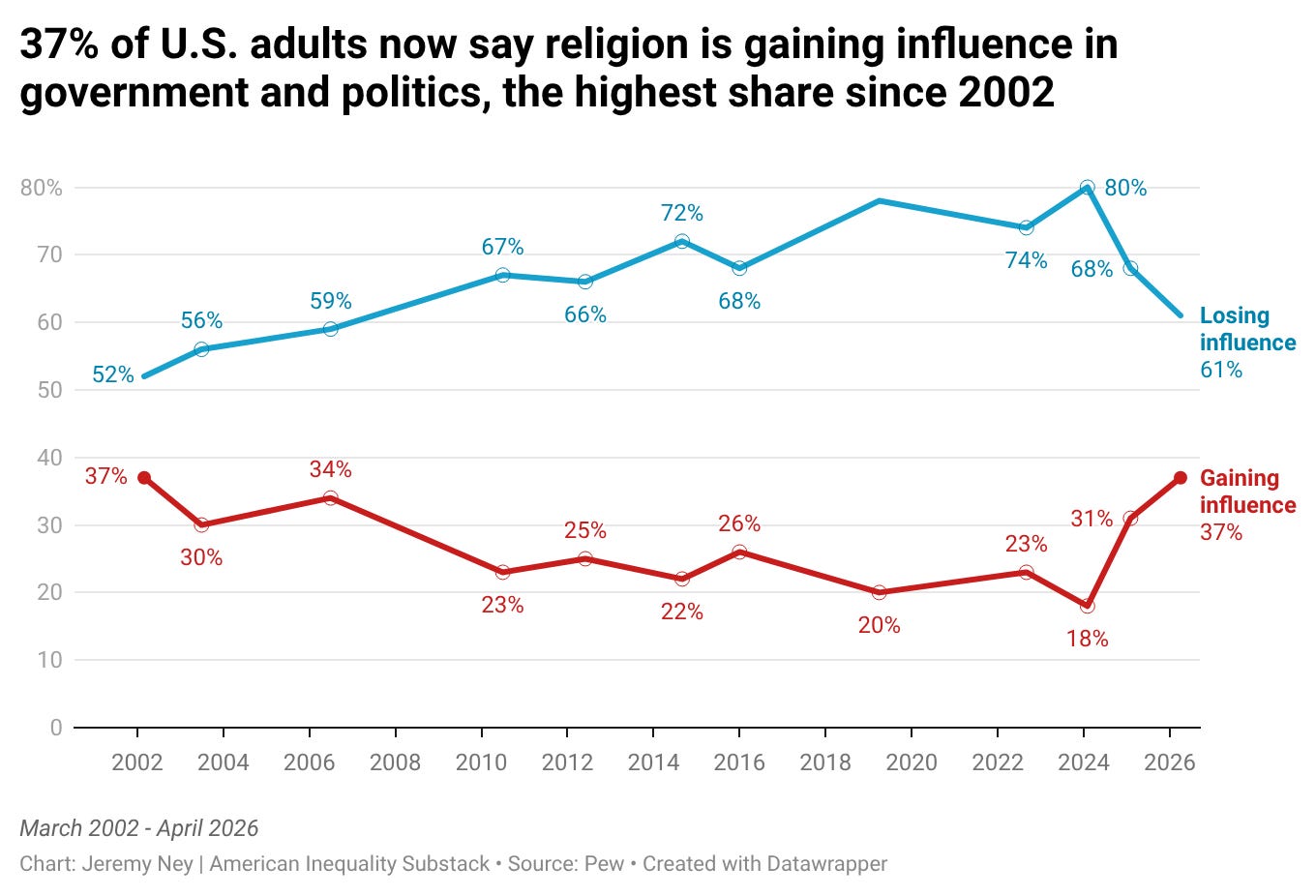
Where is God in America? We’re currently living through a time of two conflicting themes: on one hand, we’re seeing an escalation of institutional support for faith based organization. The current administration established an official White House Faith Office in the West Wing (the first of its kind) along with faith liaisons in every agency and a Task Force to Eradicate Anti-Christian Bias. Conservative judicial decisions have promoted mandatory displays of the Ten Commandments in public school classrooms. A rise in funding for school choice programs has increased private school enrollment (often in religious institutions) by 25%.
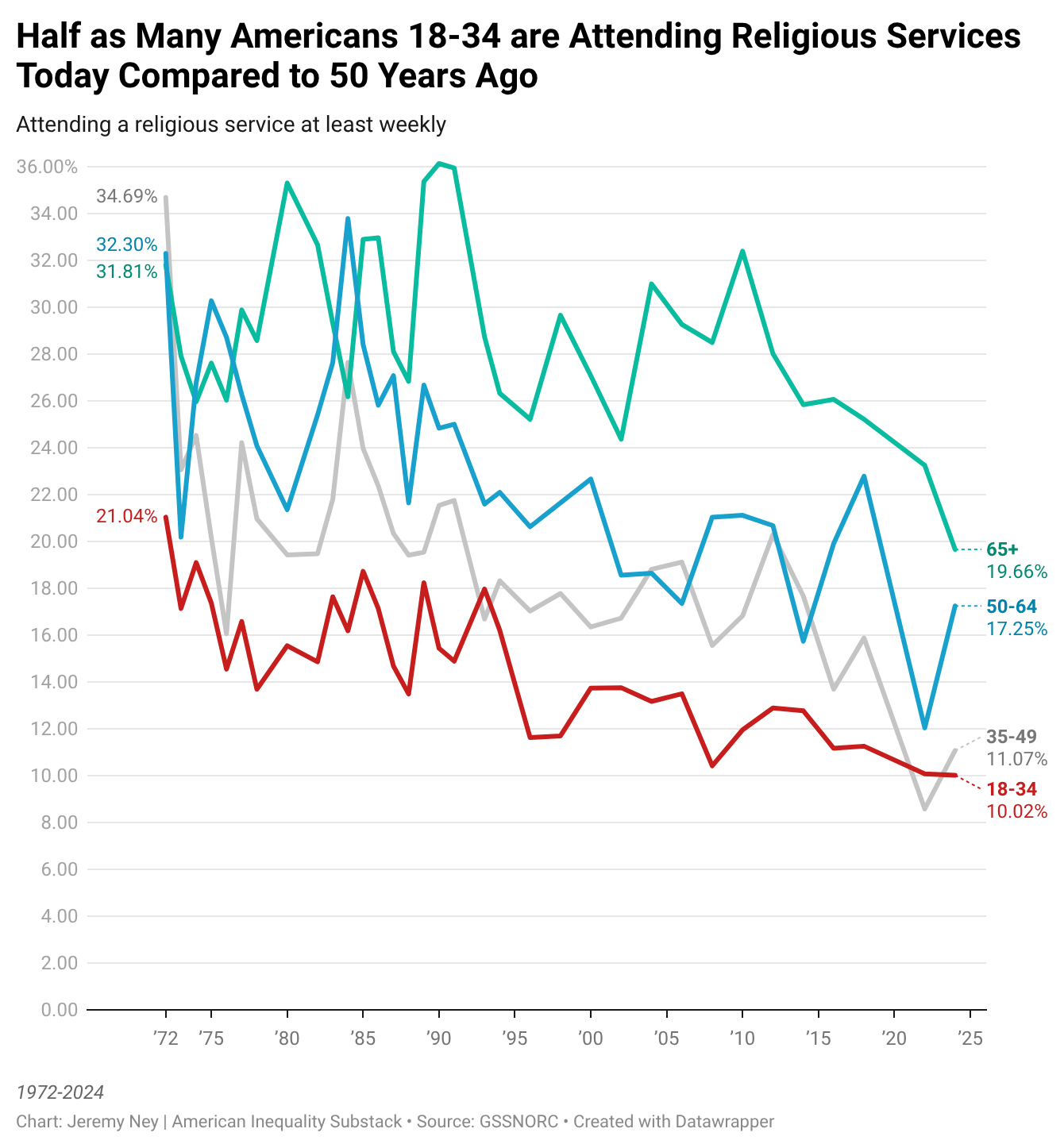
On the other hand, Americans are less religious than they’ve ever been in recorded history. Over the last decade, US religiosity has fallen 17 percentage points, the largest decline in the world. For the first time less than 50% of Americans say that religion is an important part of their daily lives.
The role of religion has a deep impact on American inequality. It often shapes the types of policies that we pursue, the “God-given rights” we defend, the donations that we make, and the community-driven narrative to love thy neighbor as thyself. When religion disappears, what happens to the social and economic fabric of the nation?
A nation grows more secular in its habits, while growing more religious in its politics
My initial hypothesis was that Republicans today were ramping up religious language and policies because they saw the importance of religion in swing states. The theory was that they believed that religion could be a winning strategy to convince local voters to join their platform, much like it was in the mid-1970s under the auspices of the “Moral Majority.” 50 years ago, conservative Christian leaders mobilized in response to cultural and legal shifts like school desegregation rulings (affecting religious academies) and the Supreme Court’s decision in Roe v. Wade (affecting a woman’s right to abortion). The Moral Majority back then explicitly fused evangelical activism with Republican politics, and the election of Ronald Reagan in 1980 proved the formula’s success. Perhaps America was returning to this formula once again.
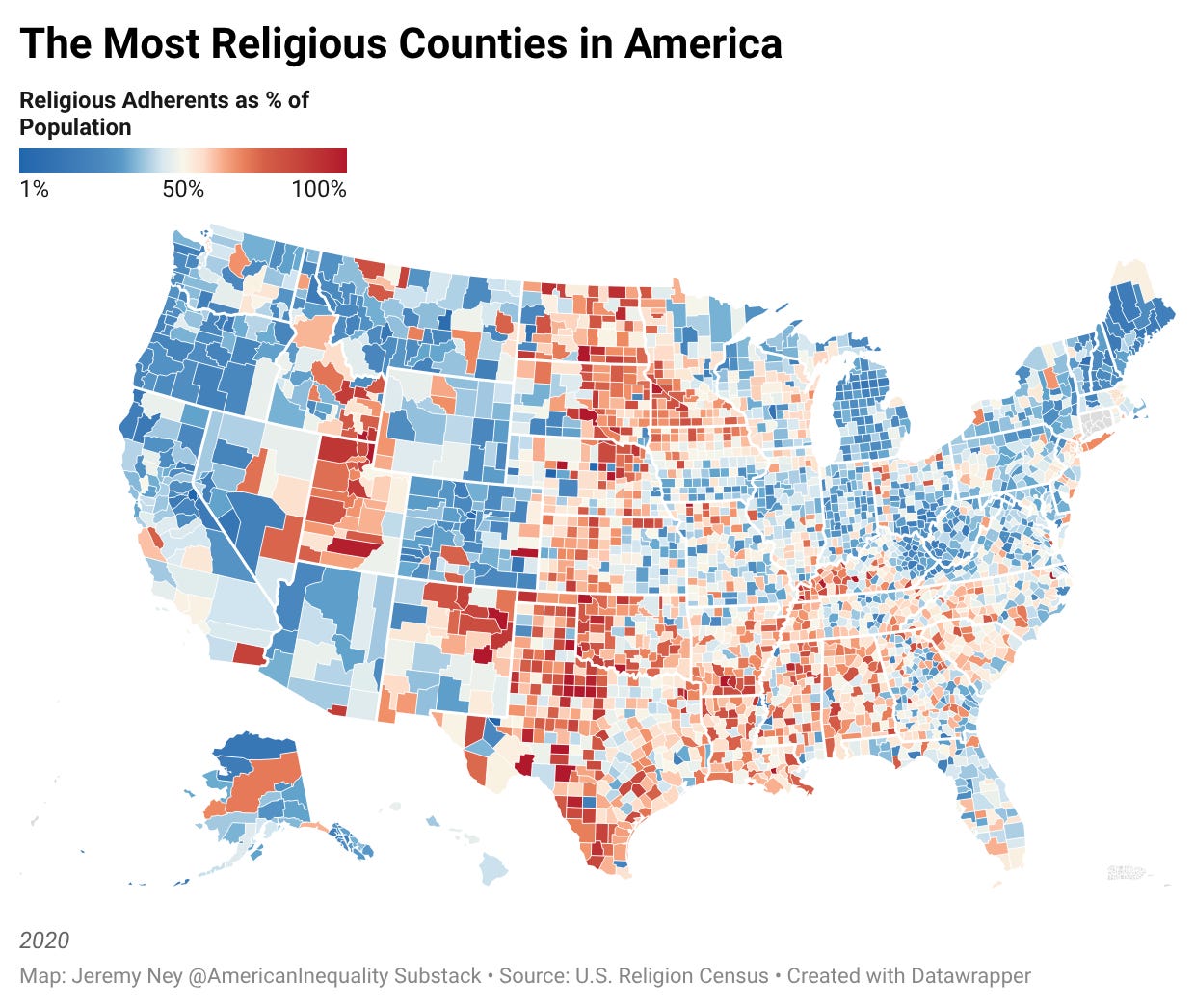
But the data reveals that my hypothesis was largely wrong. Of the 207 pivotal counties in the 2024 election—the specific battlegrounds that had flipped from Obama in 2012 to Trump in 2016—These critical regions are actually less heavily populated by religious adherents than the deep-red strongholds of the American South or the rural Midwest that were almost always going to go Republican. In other words, the most important counties in America for presidential elections don’t seem to care much about religion at all.
The Religious Keyword Index (RKI) helps shed light on this paradox. The RKI is a quantitative tool used to systematically measure the density of faith-based language across state and national party platforms and presidential speeches. The RKI data shows that Democratic politicians have progressively moved toward more secular or pragmatically inclusive language, while the Republican Party has exponentially increased its RKI score, using language much more heavily laden with words like “scripture” or “Bible” or “God” or “Christian”. If religion didn’t seem to be so important in pivotal voting counties, why were Republicans ramping up this language?
Economic historians published research using the RKI and RNC speeches to show that the transition is less about religion itself and more about a spiritual mandate grounded in Christian nationalism.
Christian Nationalism
A 2025 PRRI national survey highlighted the depth of this rhetorical alignment, finding that nearly 70% (69%) of white Christian nationalism adherents and sympathizers voted for the Republican presidential candidate. The share of U.S. adults who now say the federal government should declare Christianity the nation’s official religion has risen from 13% in 2024 to 17%. In the critical swing states of Pennsylvania, Michigan, Wisconsin, and Arizon, nearly one-third of voters are Christian national “adherents” or “sympathizers” according to the PRRI data.
The language of Christian Nationalism frequently centers on sweeping concepts like “God-given rights” and protecting America’s “founding Judeo-Christian heritage.” In his very first speech as House Speaker, Mike Johnson (who many often describe as a Christian National) proclaimed, “I believe that scripture, the Bible, is very clear that God is the one that raises up those in authority.” Prominent figures frame political battles in communities, families, the internet, as existential moral conflicts—using phrases like “safeguarding us from sin” against an overreaching “radical left”—effectively transforming standard policy debates into decrees from God to do what is right (those it is worth noting that those views are often not grounded in Biblical teachings at all).
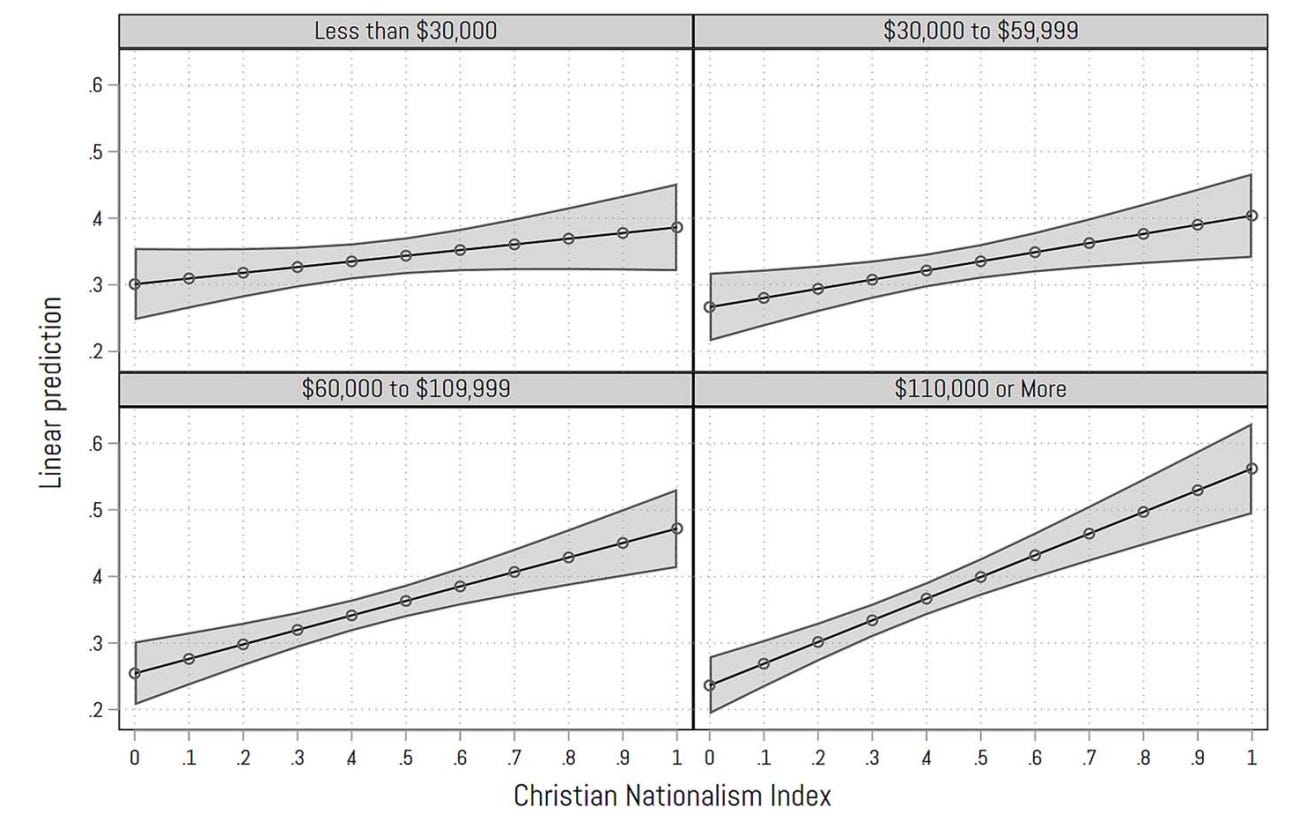
But Christian nationalism is not only about values, it is also about who has power in America. In a paper released in late April, researchers from the University of Oklahoma found that “As Americans affirm Christian nationalist views, they are more likely to (1) affirm that it is just and right that rich Americans can afford education for their children and healthcare that poorer Americans cannot and (2) approve of economic inequality in the abstract.” The richest Americans not only support more Christian nationalist views, they also “feel less angry when thinking about differences in wealth between the rich and the poor in America, disagreeing that differences in income in America are too large, and viewing the income distribution in America as mostly fair.”
A certain flavor of religiosity is starting to dominate American politics, engendering views of inequality that go far beyond income - but stretch to the way we treat women’s bodies, who has the right to get married, who can serve in the military, who deserves the death penalty, and the decency we owe to those escaping violence and seeking shelter in our great nation.
There is a reason we have enshrined a separation of church and state in our constitution.
Religion creates community, and community buffers people against poverty
Religion can act as a protective shield for poverty in America, not because of any godly intervention, but because of the role of communities. A longitudinal study published by NBER tracked the long-term upward mobility of highly disadvantaged youth over 15 years. Researchers looked at 168 distinct socioeconmic metrics including high school dropout rates, repeating grades, smoking, and divorce rates. The data showed a statistically significant relationship between how community religious participation operates as a profound structural buffer against childhood poverty and improves economic conditions along many of the 168 metrics.
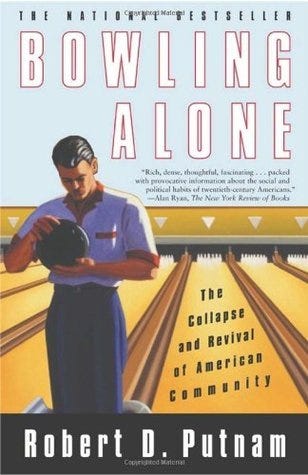
Robert Putnam in Bowling Alone offered one of the most powerful voices in showing the economic mobility and social capital benefits of religion. Putnam explicitly argues that faith communities serve as the bedrock of American civic infrastructure and social connection. His extensive research provides a framework for understanding how a decline in local religious participation erodes the very networks that foster upward economic mobility.
Houses of worship are one of the few places that can bring people together from rich and poor communities to lift each other up. A well-resourced local church or community parish creates cross-class social networks where a working-class teenager might secure a mentorship, a job recommendation, or college advice from a high-earning professional sitting in the same pew. Those types of interactions don’t emerge in most 3rd spaces. Not to mention there are 24x as many religious establishments as there are Starbucks in America.
Where are the Good Samaritans?
Religious giving in the U.S. is also experiencing a significant, long-term decline in its share of total philanthropic donations, dropping from 34% in 2011 to 23% in 2024. Median giving per household to a religious organization declined from $910 in 2021 to $600 in 2024. 1 in 3 dollars of all charitable donations was to a religious organization in 2011, but in 2024 it was just 1 in 4. For the ultra wealthy though, religious giving has gone up by 25% from 2018 to 2022. Several reports show that the ultra wealthy give to religious groups much more often than any other cause.
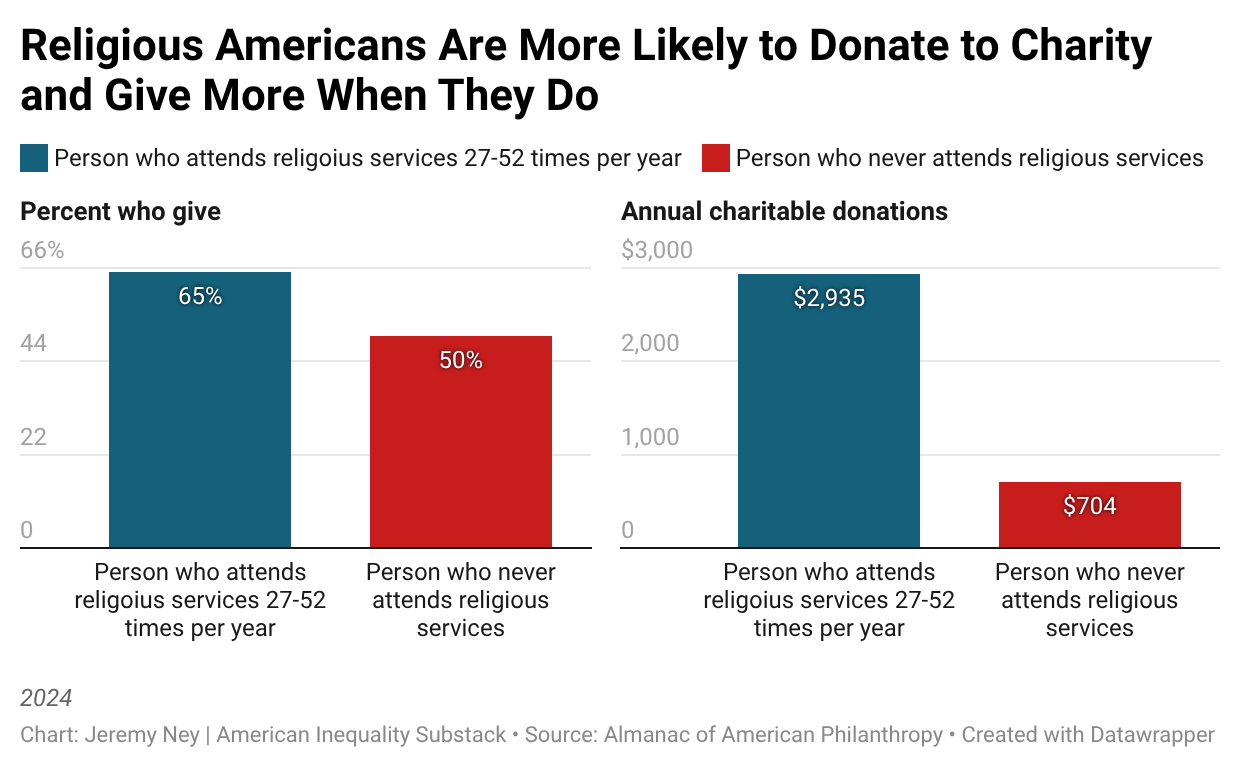
But churches are also core pillars of America’s social safety net When people start attending church or volunteering with religious groups, these benefits to the disadvantaged disappear.
58% of beds for the homeless are provided by faith-based organizations
66% of of emergency food pantries after a natural disaster are affiliated with a faith-based organization
63.2% of local food pantries operate with a faith-based affiliation.
Americans who attend church weekly are nearly twice as likely to volunteer
Religious observant Americans are 2.5x more likely to adopt a child than unaffiliated Americans
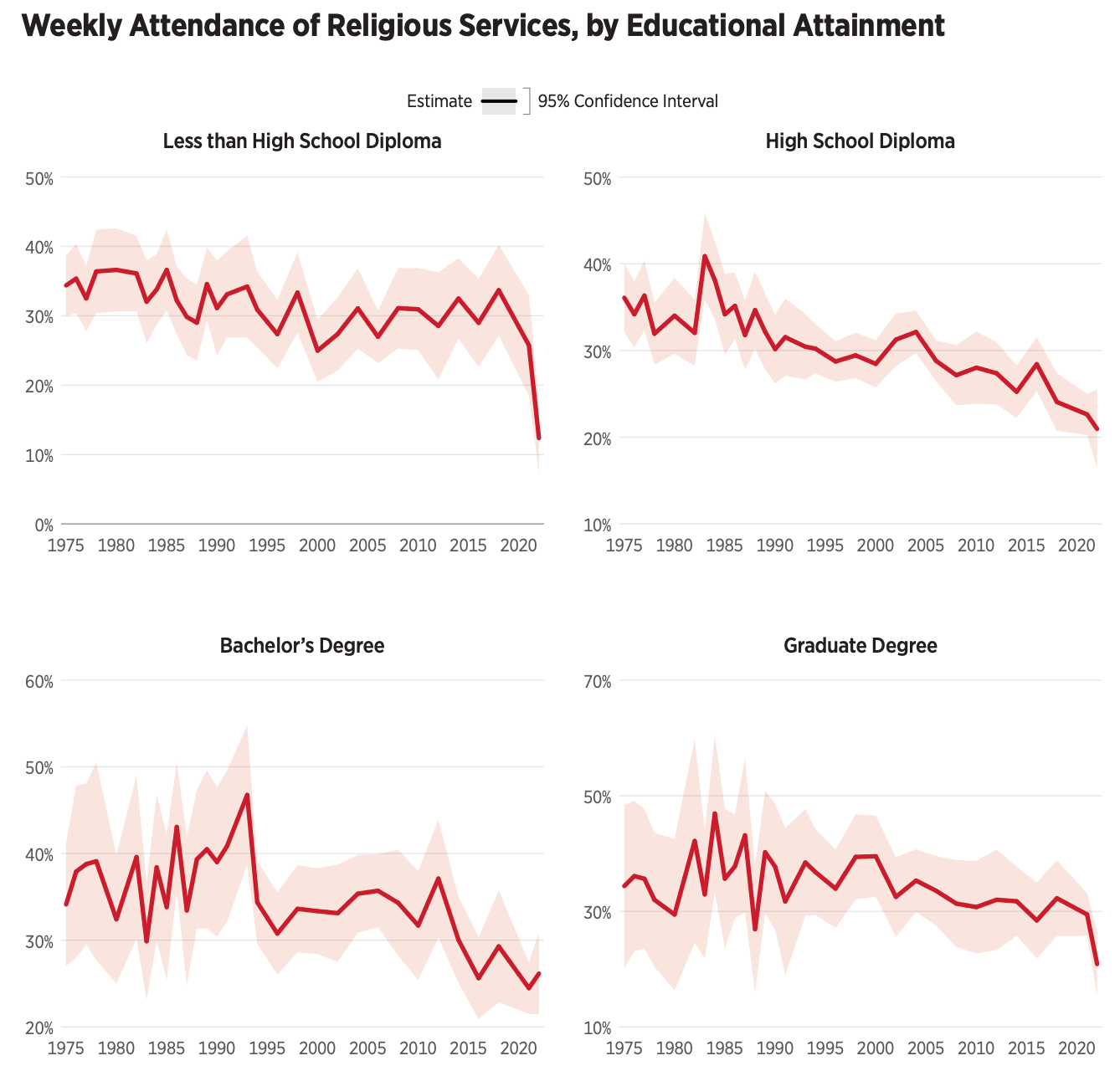
This is the dilemma of religion in America - religious connection can promote economic mobility, but religious views can also be weaponized to widen inequality. As a religious person myself, I like to believe in the power of religion to unite communities, to promote acts of loving kindness, to urge us to repair the world, and to give both time and money to those less fortunate.
We are living in a time where institutional religion wields significant power over public policy. Those real-world communities that could insulate Americans from poverty are rapidly disappearing. While the solution does not have to be grounded in bringing religiosity back into America, it does have to be grounded in the ideas of looking after one’s neighbor and trying to lift people up through local connections. We may be losing our faith, but we cannot afford to lose each other.
INTERESTING ON THE WEB
Voting rights mapped across the world and a downloadable dataset for deeper analysis, showcases that the U.S. is an outlier in really bad voting rights (“Unlike 82% of OECD countries, the US does not automatically register voters nationwide.” - Equal Futures
Some of my favorite stats on inequality are covered in this article (lending, wages, productivity, consumer concerns) - Better Markets
Fascinating new study relying on the phased global rollout of the iPhone via AT&T from 2007-2011 showing that 33–52% of the decline in the general fertility rate among women aged 15–44 - NBER
We know the Trump administration is deleting data, but this report reveals the core ways that data deletion hurts real people - The Guardian
I’m launching new perks for the newsletter, and if you are an author working an upcoming book and think it will be interesting to the American Inequality audience - Check this out
The current administration established an official White House Faith Office in the West Wing (the first of its kind) along with faith liaisons in every agency and a Task Force to Eradicate Anti-Christian Bias.
I don't know, but ... if Christains want to "eliminate anti-Christian bias," maybe they could stop acting like dicks?
It is quite the fallout, as your data and analysis have shown. Thanks for this enlightening piece, Jeremy.