

Alcohol Fuels a Dangerous Divide
Why drinking deaths fall by half by crossing from Nevada to Utah

INTERESTING ON THE WEB
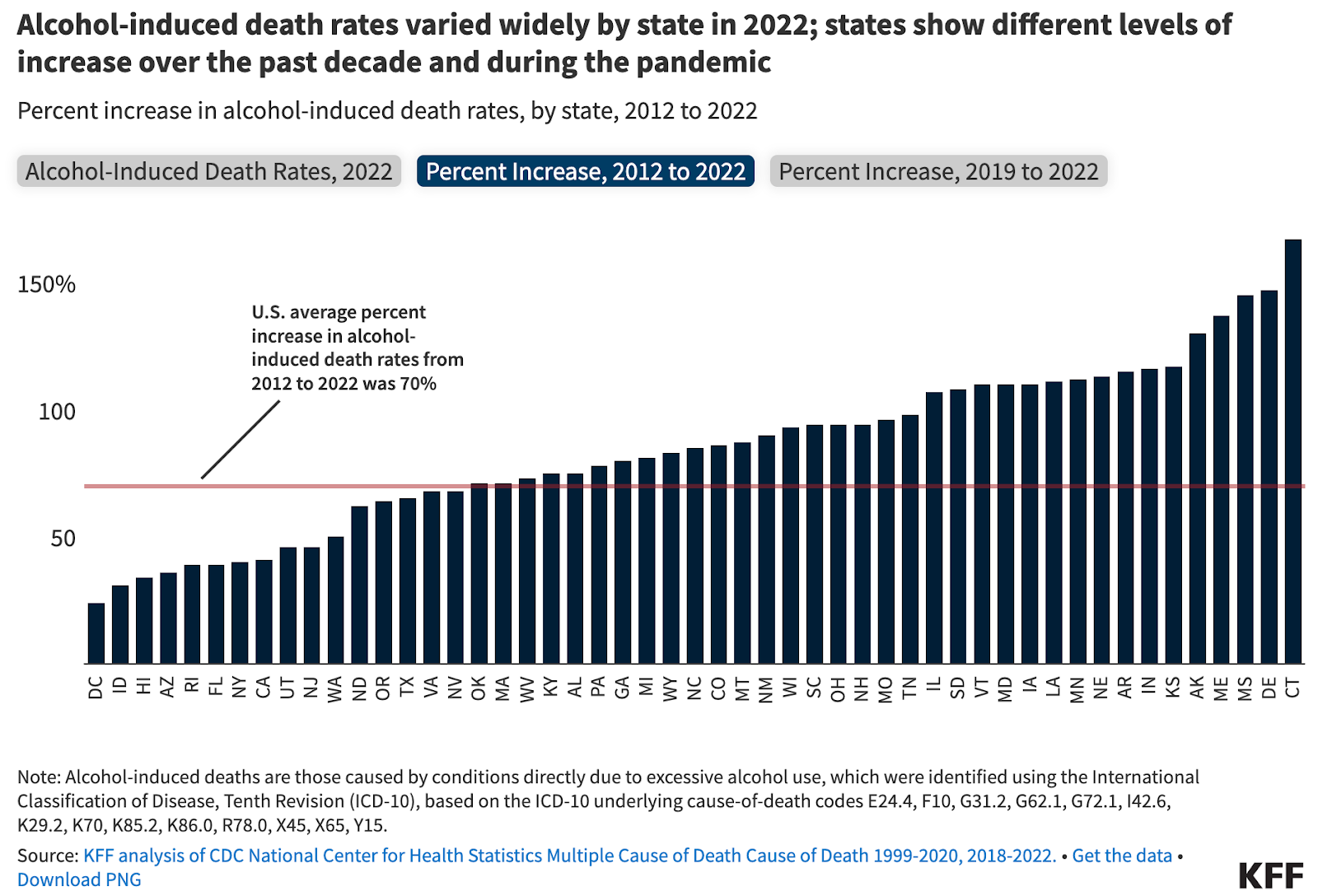
Alcohol is one of the worst killers in America. Alcohol kills more people than opioids and suicides combined each year. Every 3 minutes, 1 person dies in America due to alcohol abuse, according to data from the CDC. By the time you finish this article, at least one person will be dead. Alcohol shortened the lives of those who died by an average of 24 years, leading to 4 million years of potential life lost. The number of alcohol-related deaths more than doubled among Americans between 1999 and 2020.
On August 13, Gallup Poll released survey results reporting that only 54% of U.S. adults said they consumed alcohol, the lowest percentage in Gallup’s 90 years of collecting data on drinking behavior. Those who did drink alcohol said they were consuming less, the poll found.
At the same time, I consistently hear this strong narrative that alcohol consumption is good because it also means higher socialization. “What’s wrong with young people today? They don’t get drunk any more,” declared one Guardian headline. “Champagne sales are down. Are parties dying too?” asked another WaPo piece. “We may have already hit peak booze,” wrote another Bloomberg article that praised a beloved tradition. There’s an adage that “Every drink takes five minutes off your life.” In January 2025, Derek Thompson wrote an Atlantic article that captured something a bit odd about this phrase. “Maybe the thought scares you. Personally, I find comfort in it,” Thompson wrote.
For years Americans were fed a false idea that alcohol might be good for you. “There was this perception that a glass of red wine with dinner every night might actually help you live longer,” said Dr. Scott Hadland, the chief of adolescent and young adult medicine at Mass General for Children and an addiction specialist. In the 1990s, some doctors even encouraged moderate drinking.
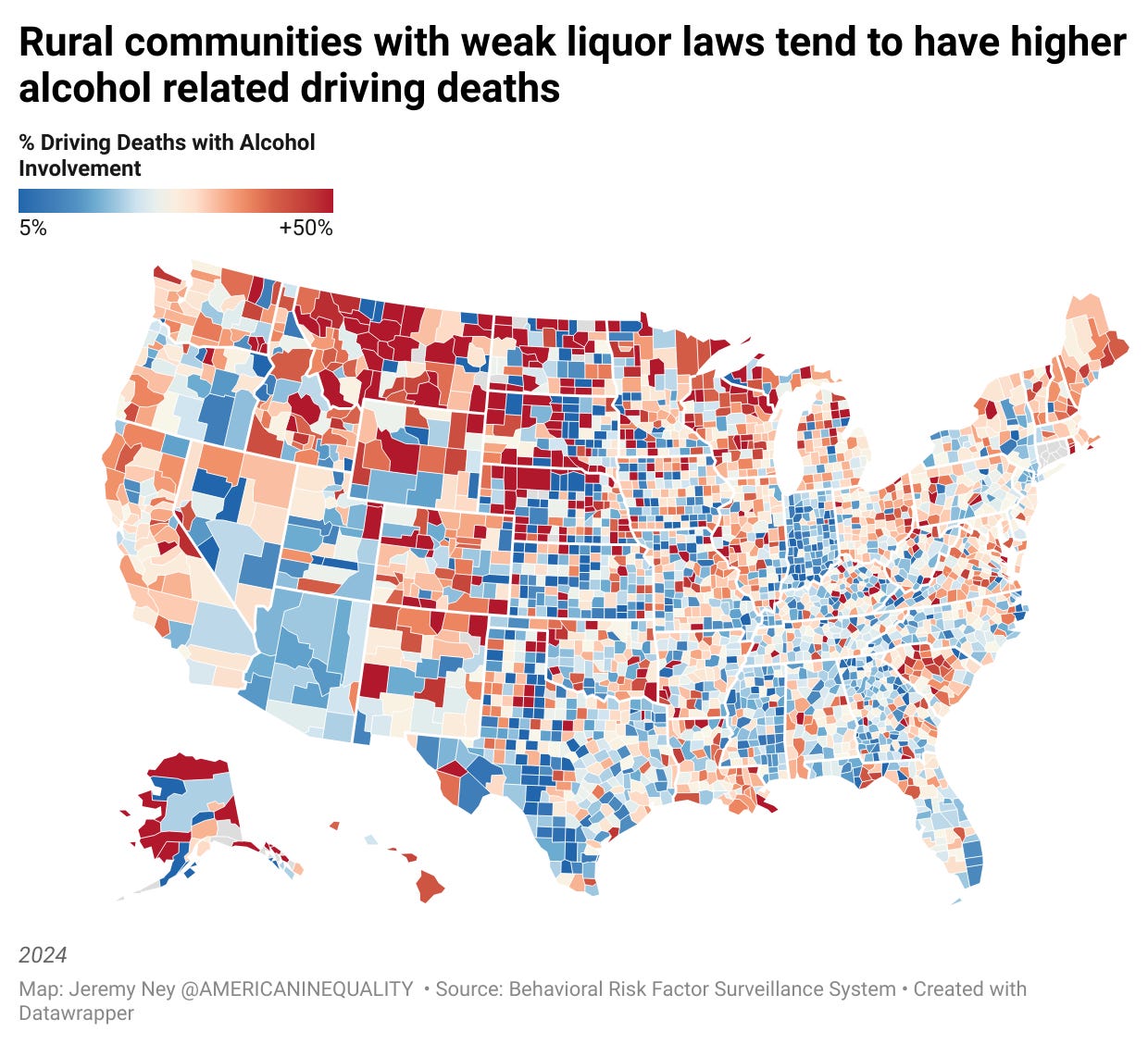
Consumption of alcohol is unequivocally dangerous for communities. Depending on where you are born, you may be far more likely to die from alcohol than in other parts of the U.S. Lax state liquor laws, lower enforcement of those laws, or higher rates of drunk driving – particularly in rural areas — may kill you at a much younger age. When it comes to different demographics, some communities are far more likely to suffer from the onslaughts of alcohol than others.
STATE IMPACTS OF LAX LIQUOR LAWS
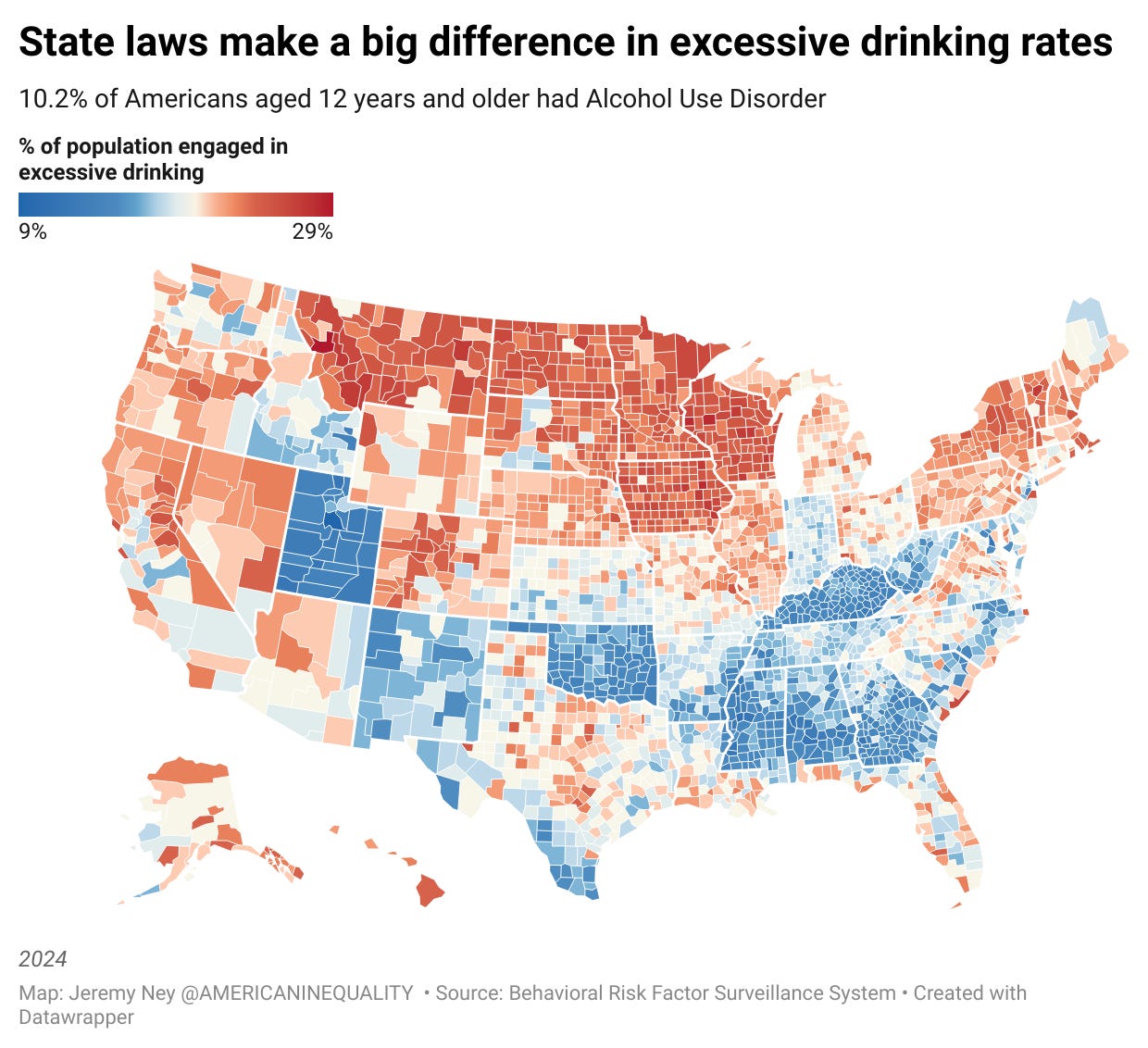
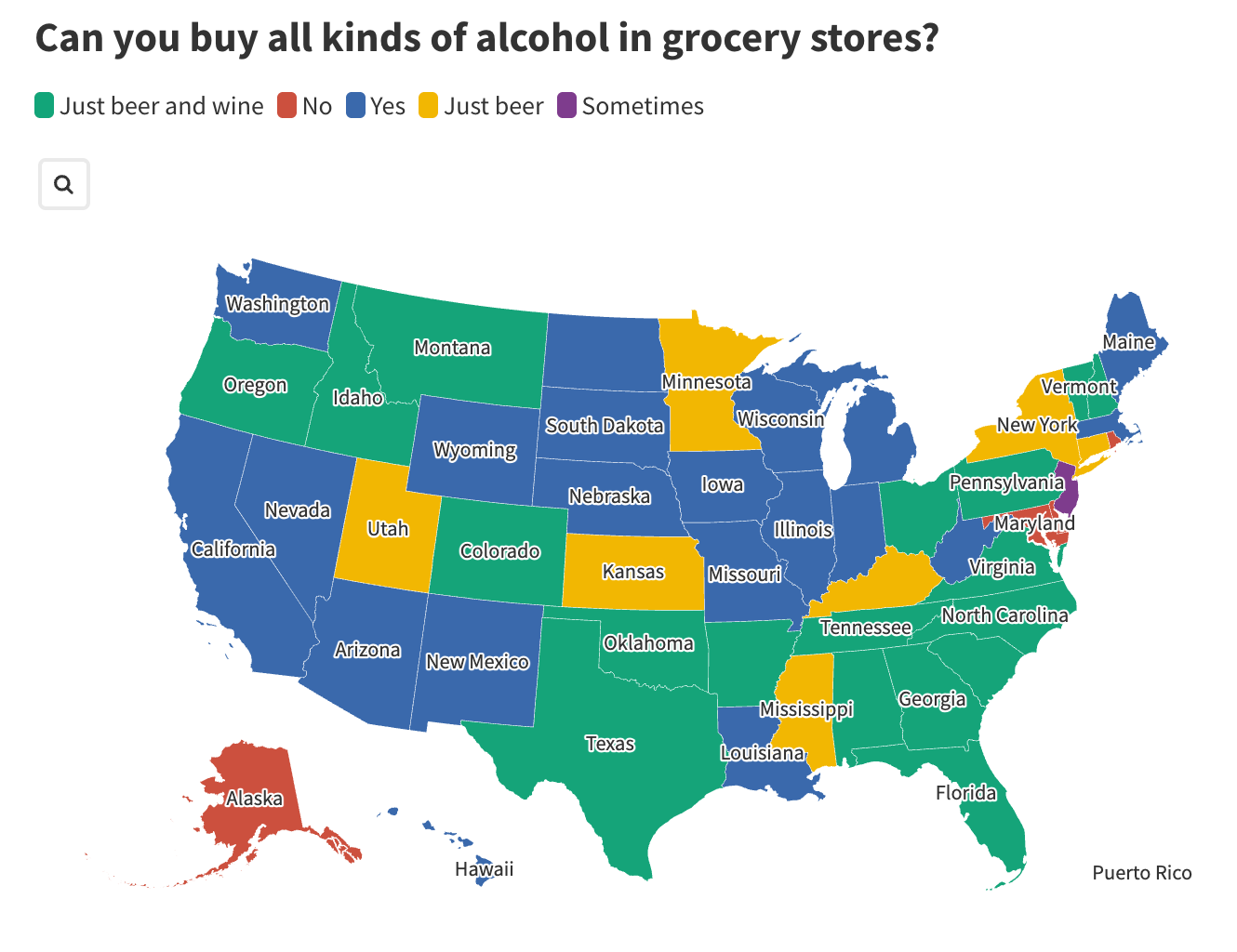
Inequalities in alcohol’s impact on communities is clear in the data. Stepping just a few feet across the state border from Lincoln County, Nevada to Washington County, Utah drops the excessive drinking rate by half, from 24% to 12%. Nevada has the weakest liquor laws of any state in the nation while Utah has some of the strongest. Las Vegas drives Nevada’s lax liquor laws, permitting people to buy liquor 24/7, to enshrine that public intoxication is not a crime, to ban “last calls” at bars, and to codify no state-level Alcoholic Beverage Control (ABC) law, meaning there are no state regulations on labeling, advertising, or retail outlets for alcohol.
Utah, on the other hand, has a high mormon population and high altitudes which led to high restrictions on alcohol: You must order food if you’re ordering alcohol at a restaurant, all liquor bottles need a ‘metered-pour’ which control how much alcohol is dispensed from a bottle, beer at grocery stores can’t be more than 5% though this was recently 3.2%, and liquor can’t be purchased on Sundays.
The death rate from alcohol in Nevada is twice as high as it is in Utah.
Differences in saws aren’t the only thing that causes death rates to change — low enforcement of those laws also leads to unequal outcomes. Up until 2023, Wisconsin was one of only a handful of states that didn’t have a dedicated office charged with enforcement of alcohol laws. One official explained that alcohol enforcement in the state “went to hell” for decades as lobbyists helped wholesalers skirt many state laws, like shipping beers directly to consumers. Wisconsin is “locked in this weird death grip with alcohol,” said John Eich, director of the Wisconsin Office of Rural Health. “There’s a cultural level of acceptance of excessive drinking.” Wisconsin ranks the highest in the nation for excessive alcohol use which includes binge drinking, drinking while pregnant, heavy drinking and underage drinking. The powerful trade group the Tavern League of Wisconsin and the well-rehearsed phrase “Drink Wisconsibly” all reinforce this culture. Drinking deaths for Wisconsinites sites tripled from 6.7 to 18.5 per 100,000 from 1999 to 2020.
States with lax liquor laws have far higher death rates from alcohol and more drunk driving incidents. While culture and enforcement of these laws are a factor too, inequality in outcomes persist depending on which side of a state border a person is born on.
INEQUALITY FROM ALCOHOL
Inequality is rampant when it comes to how different communities experience alcohol:
Native Americans are five-times more likely to die from alcohol abuse than their White peers, largely because support for these communities is far lower
Low-income Americans are twice as likely to die from alcohol as their high-income peers
Liquor stores tend to concentrate in low-income or high-poverty communities
When sin-taxes are lowered on alcohol or prices decline, low-income people die at higher rates from the change than high-income people do
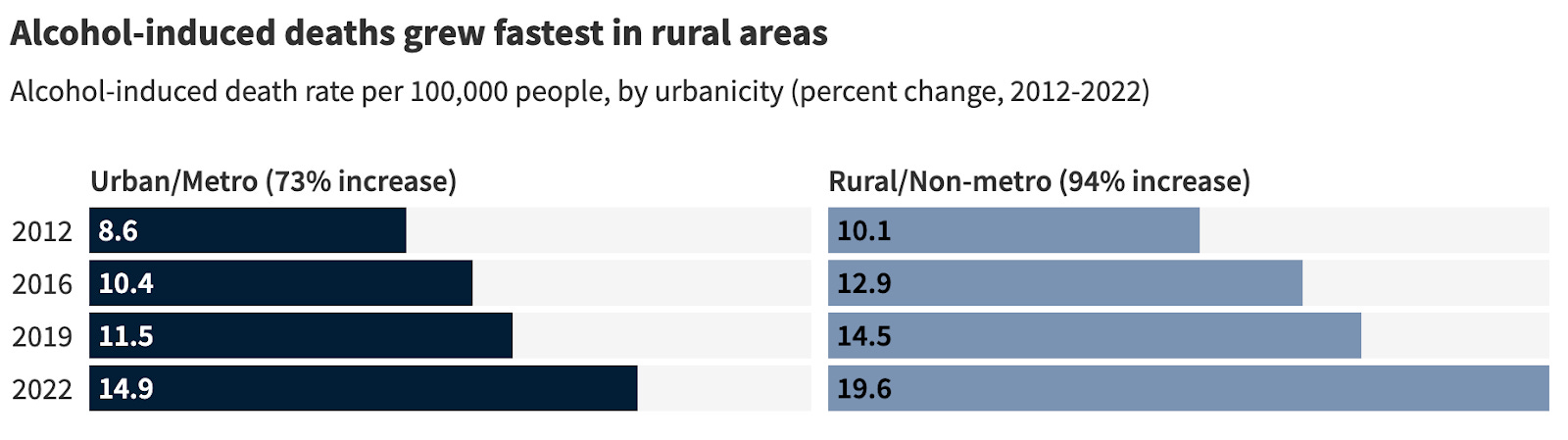
Men in rural areas are 18% more likely to die from alcohol compared to their urban peers (controlling for income, education, and demographics). Rural women were 23% more likely.
Men who are dependent on alcohol are six-times more likely to be arrested for threatening, attacking or sexually assaulting their wives, girlfriends or female ex-partners than men who are not dependent.
A POSITIVE TREND
Last year was the first on record, going back to 1975, that fewer than 50 percent of high school seniors said they’d ever had a drink of alcohol. As recently as 1989, the share was higher than 90 percent. While some view this as a negative sign that teens are not socializing enough or not taking enough risks, I view it as a positive sign. Alcohol is bad for communities and especially bad for young people. Mounting research suggests that even a little alcohol takes a toll on the body, damaging DNA. Last year, Dr. Vivek Murthy, then the surgeon general, stressed that drinking caused preventable cancers and called for alcoholic beverages to carry warning labels, like cigarettes. Let’s not conflate alcohol and socialization.
Only 50% of those aged 18 to 34 said they drank alcohol, the same as in 2024 and down from 59% in 2023. Just 56% of respondents 35 to 54 said they drank alcohol, falling from 70% in 2024.
THE PATH FORWARD
Stricter state laws — Utah offers an example of the best state alcohol laws in the nation. Communities would benefit tremendously from following Utah’s example. Specifically, Utah is the only state in the nation that has a blood-alcohol content (BAC) limit of 0.05%. Every other state is 0.08%. A 2022 study from the National Highway Traffic Safety Administration Utah’s fatal crash rate dropped by 19.8% in 2019, the first year under the lower legal limit, and the fatality rate decreased by 18.3%. The neighboring States of Arizona, Colorado, and Nevada did not show the same levels of improvement in fatal crash and fatality rates as Utah. 22% of those who drank alcohol indicated they had changed their behaviors once the law went into effect. Other laws that have shown to be beneficial are: (a) higher alcohol taxes; (b) Limiting days/hours of sale; and (c) enforcing dram shop liability laws, which means that places selling alcohol are responsible for the injuries or harms caused by illegally serving certain customers.
Limit alcohol establishment density, particularly in high-poverty areas: One study published in the Journal of Community Psychology that for every 1-unit increase in liquor store outlet density, there was a 7.3-year decrease in life expectancy. Areas with poverty rates exceeding 20% typically show 50% higher concentration of liquor stores and historically redlined areas tend to have much higher concentrations of establishments that sell alcohol. Los Angeles, Minneapolis, and Baltimore have all passed zoning regulations or passed laws that capped the number of liquor licenses in certain neighborhoods to reduce outlet density. Studies from UNC and Johns Hopkins have found that policies like these can prevent hundreds of homicides and save tens of millions of dollars each year.
Over the last few years, the health harms of drinking have come into focus. Mounting research suggests that even a little alcohol takes a toll on the body, damaging DNA. Last year, Dr. Vivek Murthy, then the surgeon general, stressed that drinking caused preventable cancers and called for alcoholic beverages to carry warning labels, like cigarettes. Hopefully this change can overpower the narrative that alcohol and socialization go hand-in-hand and that people can find a much safer way to spend time with each other.
I think a lot of people have dropped alcohol in favor of marijuana.
Hate to call B.S. but B.S. Look at the map, look at the blue, what do you find: Evangelical Christians and Mormons out West. Old fashioned Lutherans in the Mid-West. Its culture and religion driving behavior, not laws.